

Corporate Governance
Legal Compliance and Anti-Corruption
1. Corporate Governance Policy, Business Code of Conduct and Related Laws of the Company
The Board of Directors plays an important role in guiding the Company’s business direction, monitoring management performance, and establishing good corporate governance policies, business ethics, anti-corruption policies, and other relevant laws, rules and regulations. The Board oversees corporate governance for the best interests of the Company and shareholders, and ensures that the Company conducts its activities in compliance with the law.
The Company requires directors, executives, employees, and related parties to comply with the policies and practices related to good corporate governance, including the Business Code of Conduct, as specified in the Good Corporate Governance Policy Manual and the Business Code of Conduct document.
Corporate Governance HandbookCode of Conduct
2. Performance of Compliance with Corporate Governance-Related Policies in the Past Year
The Board of Directors has established a policy for receiving complaints and whistleblowing reports related to fraud, corruption and bribery. The policy sets out guidelines, procedures, and appropriate protection measures for whistleblowers acting in good faith. It also provides channels for reporting violations of law or the Code of Conduct, behavior that may indicate fraud or misconduct, and cases where stakeholders’ rights may have been violated, including matters that may be raised directly with the Board of Directors.
Complaint and Whistleblowing Measures
The Company has established a confidential whistleblowing mechanism to provide a convenient channel for employees and external parties, including contractors, joint venture companies, other persons working with the Company, other external stakeholders, and the general public who witness or have concerns about misconduct, abnormal behavior, or rights violations within the Company group, or who wish to submit constructive suggestions.
Complaint Handling Process
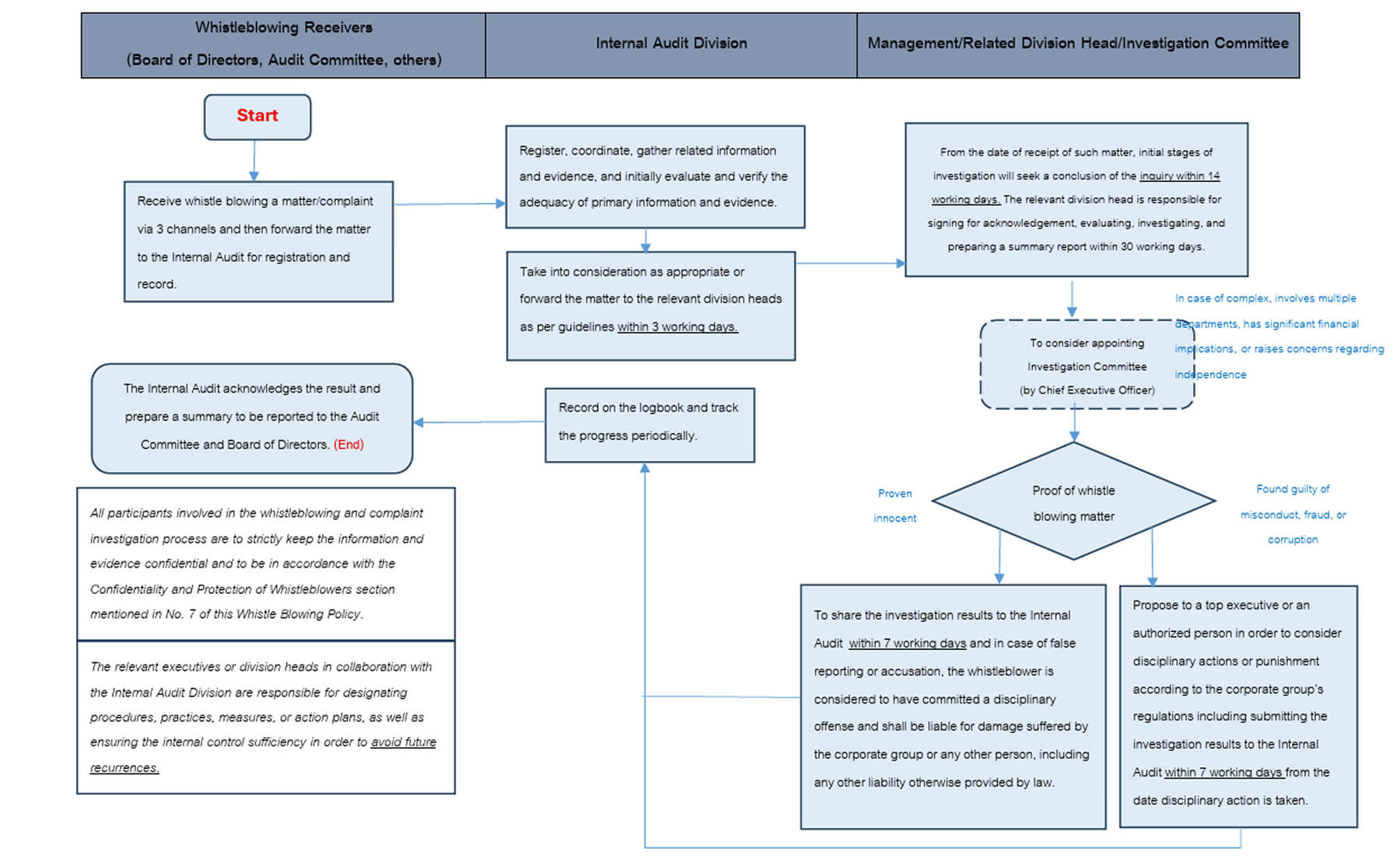
Whistleblowing Channels
Complaints/Whistleblowing Reports in the Past Year
| Whistleblowing issues | Reported | Investigated | Completed |
|---|---|---|---|
| 1. Suspected corruption | 4 | 4 | 2 |
| 2. Superiors and workplace environment issues | 3 | 3 | 3 |
| 3. Individual behavioral issues | 1 | 1 | 1 |
| 4. Product and service quality complaints | 1 | 1 | 1 |
| 5. Unfounded / False allegations | 2 | 2 | 2 |
| 6. Product inquiries and support requests | 1 | 1 | 1 |
The Company has strictly complied with the policy. The Internal Audit Department is responsible for collecting information and coordinating with relevant parties to evaluate, verify, and investigate facts in accordance with the complaint and whistleblowing process and procedures.
In addition, the Internal Audit Department coordinates with executives of relevant functions to use information received from complaints and whistleblowing reports to improve work processes and internal controls, in order to develop and prevent future issues. Internal Audit reports the receipt of complaints and whistleblowing reports, as well as preventive measures for future issues, to the Audit Committee and the Board of Directors, respectively.
Anti-Bribery and Anti-Corruption Policy
The Board of Directors approved the policy and related practices, which are regularly reviewed together with the Risk Management and Sustainability Committee. The principles have been incorporated into the Business Code of Conduct and include the following key matters:
Prohibitions and penalties: The Company prohibits directors, executives, and employees at all levels from performing duties or exercising authority improperly, violating laws and ethics, or being involved in any form of fraud, corruption, or bribery, whether directly or indirectly, with government officials or other persons in the private sector doing business with the Company. Personnel who violate or fail to comply with the policy will be subject to disciplinary action in accordance with the Company’s regulations and may also be subject to legal penalties.
Internal control and procurement system: The Company has strictly established procurement and disbursement procedures, requiring clear supporting evidence and appropriate approval authority. The Company also provides processes to review and assess the adequacy of internal controls related to anti-corruption and anti-bribery.
The Company assesses risks related to fraud, corruption, and bribery, including current risks and emerging risks, determines risk management measures, reviews risk levels, and monitors actions to keep risks within an acceptable level. This supports the development of appropriate and comprehensive preventive measures in line with applicable laws.
Awareness building and communication: The Company regularly communicates, provides training, prepares teaching materials, and promotes matters related to anti-corruption and anti-bribery, including the giving and receiving of gifts, to employees at all levels so they understand and apply the policy in practice.
Whistleblowing: The Company has established a whistleblowing policy that specifies multiple complaint channels so that employees and external parties can report clues or complaints. Strict measures are in place to protect whistleblowers’ identities. The Company also maintains a complaint register and assigns responsible persons to investigate, follow up, summarize results, and propose corrective actions for reporting to the Audit Committee and the Board of Directors. The Company encourages personnel who observe actions contrary to policies or ethics to report such information to supervisors, relevant departments, or through the channels specified by the Company immediately.
No Gift Policy
The Company has established this policy to prevent giving or receiving bribes. It provides clear practices for giving and receiving gifts by setting prohibitions and conditions that directors, executives, and employees should follow. Key points are summarized as follows:
Prohibitions: Do not receive money, items, entertainment, or any other benefits that may constitute fraudulent or bribery-related behavior.
Conditions for giving and receiving gifts: Gifts must be reasonable and customary, must not create business obligations, must not affect business decisions, and must not be cash. Transparency and verifiability are key principles.
In 2025, the Company publicized a no-gift campaign during the New Year festival on the Company’s website to communicate its anti-corruption commitment to business partners.
In addition, the Company prepared internal communication posters and sent them by email to employees at all levels regarding Do’s and Don’ts to prevent behavior that may constitute fraud, corruption, or bribery.
Violation Statistics
| Details | Year 2025 |
|---|---|
| Ethical Misconduct by Executives and Directors | None |
| Significant Corruption and Bribery Misconduct | None |
| Fines, Penalties, and Corruption-Related Settlements | 0 THB |
1. Shareholder Rights
The Company places importance on shareholder rights, not limited only to legal rights, but also promotes shareholders’ full exercise of their rights. Fundamental shareholder rights include buying, selling or transferring shares, receiving profit sharing, receiving sufficient information, attending meetings, and voting to appoint or remove directors, appoint auditors, approve significant transactions, and approve matters affecting the Company, such as dividend allocation, amendments to the Articles of Association and Memorandum of Association, capital reduction or increase, and approval of special transactions.
The Company also has practices to promote and facilitate the equal exercise of rights by all shareholders by continuously supporting shareholder participation, communication, and protection of minority shareholder rights.
2. Shareholders’ Meeting
For the 2025 Annual General Meeting of Shareholders, the Company complied with the guidelines of the AGM Checklist project prepared by the Thai Investors Association, the Thai Listed Companies Association, and the SEC as follows:
Actions before the shareholders’ meeting date
The Company scheduled the 2025 Annual General Meeting of Shareholders on April 25, 2025 in an online electronic meeting format (E-AGM).
The Company gave minority shareholders the opportunity to propose meeting agenda items and nominate persons for election as directors in advance from October to December 2024.
The Company notified shareholders of the Board resolution setting the date of the 2025 Annual General Meeting of Shareholders 60 days in advance through the Stock Exchange of Thailand’s news disclosure system and the Company’s website at www.toagroup.com.
The Company published the invitation documents in both Thai and English on its website 32 days before the meeting, starting March 24, 2025, and sent the invitation documents to shareholders 25 days in advance on April 3, 2025. This exceeded the corporate governance assessment criteria. The Company also published a meeting notice in newspapers for 3 consecutive days, April 16–18, 2025, 8 days before the meeting.
Actions on the shareholders’ meeting date
The Company used registration and vote-counting software provided by Inventech Systems (Thailand) Co., Ltd., using a barcode system for fast registration and shareholder convenience.
On the meeting date, 6 directors attended the meeting, representing 100% attendance, together with senior executives, the auditor, and legal advisors.
During the meeting, the Company explained the quorum, voting procedures, and vote-counting procedures before the meeting began. The vote-counting inspector was a legal advisor from Weerawong, Chinnavat & Partners, and an observer from the Thai Investors Association was also present.
In addition, the Chairman conducted the meeting according to all agenda items notified to shareholders in advance, without adding or changing agenda items, and provided shareholders with full opportunity to ask questions.
After the meeting was completed, the Company disclosed the resolutions together with voting results, clearly stating the votes for agree, disagree, and abstentions, on the same day through the Stock Exchange of Thailand’s system. The Company also prepared minutes containing complete key information, submitted them to relevant authorities, and published them on the website within 14 days.
The Company recorded video throughout the meeting and stored electronic traffic data of all meeting participants as required by the Emergency Decree on Electronic Meetings.
3. Information Disclosure and Investor Relations
The Company’s Investor Relations Department serves as the center for public relations and disclosure of important Company information that is useful for investment decisions by investors in the Stock Exchange of Thailand and securities analysts in analyzing the Company. Such disclosure is supervised by the Chief Executive Officer and is conducted in accordance with the Company’s disclosure policy.
Information Disclosure PolicyMaterial Information Prepared and Disclosed Periodically by Investor Relations
| Quarterly Disclosures | Annual Disclosures |
|---|---|
| Quarterly Financial Statements | Annual Financial Statements |
| Quarterly MD&A* | Annual MD&A* |
| Quarterly Investor Presentations and Key Financial Highlights | Annual Report (56-1 One Report) |
Remarks: *MD&A stands for Management Discussion and Analysis
Information and Disclosure Channels
| Information Disclosure Channels |
|---|
| 1. Company website : https://investor.toagroup.com/en/home |
2. In-house activities:
|
| 3. External activities: Roadshow Both Domestic and International Roadshows |
| 4. Public release: Newspaper, magazine, television, radio, Company’s papers, or print media, etc. |
| 5. SET Website: Opportunity Day |
Investor Relations Activities in 2025
| Activities | Times | Objectives | Attendees | Management’s Attendance |
|---|---|---|---|---|
| Annual General Meeting of Shareholders (AGM) |
1 | To report annual performance and propose agendas for acknowledgment and approval for regulatory-mandated matters. |
|
|
| Analyst Meeting | 4 | Informing quarterly operating performance. |
|
|
| Opportunity Day | 2 | Informing quarterly operating performance. |
|
|
| Company Visits and Conference call |
37 | Facilitating investor meetings to address inquiries regarding operations, outlook, and strategy. |
|
|
| Roadshow | 2 | Communicating the Company's operational overview, strategic direction, and corporate strategy. |
|
|
Shareholders and investors may contact the Investor Relations officer at:
Contact Investor Relaaions OfficerConflict of Interest Prevention Policy
The Company has established a Conflict of Interest Policy to ensure that all business decisions are made in the best interests of the Company and its shareholders. Accordingly, directors, executives, and employees must avoid any actions that could lead to a conflict of interest. Anyone who has a conflict of interest or a stake in a particular transaction must disclose their relationship or interest to the Company, abstain from participating in the deliberations, and hold no approval authority for that transaction. To this end, the Company has instituted guidelines rooted in these core principles for all directors, executives, and employees to strictly adhere to.
Directors’ Conflict of Interests Reports
The Board of Directors requires directors and executives to disclose information on their interests and related persons annually for consideration of transactions that may create conflicts of interest, in accordance with the Company’s approval procedures for related-party transactions.
In 2025, the Company Secretary collected Directors’ Conflict of Interests Reports prepared by each director and presented them to the Board of Directors every 6 months. The reports were presented twice, on July 16, 2025 and January 19, 2026, representing 100% completion, with regular monitoring of conflict of interest prevention.
In addition, directors and executives who have an interest in transactions with the Company must not participate in decisions on such transactions, must leave the meeting, and must abstain from voting on that agenda item. The Company Secretary records the names of directors and executives with interests in the agenda item and the nature of the relationship, if any, in the meeting minutes.
Insider Information Prevention Policy
Communication of the Insider Information Prevention Policy and Rules for Trading the Company’s Securities
The Company Secretary prepared documents explaining the criteria and requirements of the Insider Information Prevention Policy. The key content prohibits directors, executives, and employees from using inside information for improper benefit, and requires directors and executives to notify the Company Secretary 1 day before trading the Company’s securities.
Notification of the Company’s Securities Trading Embargo Periods
- The Company Secretary sent email reminders to directors and executives regarding the Company’s securities trading embargo periods, requiring no trading at least 1 month before disclosure of financial reports and at least 24 hours after information has been disclosed to the public, for every quarter and annual period.
Reporting Securities Holdings of Directors and Executives
- The Company requires directors and executives who are responsible for reporting securities holdings to submit reports to the Company Secretary every time securities are purchased, sold, transferred, or received by transfer, for data collection.
- The Company Secretary prepared summaries of securities holdings and changes in securities holdings of directors and executives and reported them to the Board of Directors every 6 months. In 2025, this reporting agenda was presented to the Board of Directors for acknowledgement twice, at meetings in Q3/2025 and Q1/2026.
- The Company disclosed the report on securities holdings and changes in securities holdings of directors and executives for the past year in Attachment 1 of the Annual Report (Form 56-1 One Report).
Awareness Building
In 2025, the Company provided training to all new employees on confidentiality, insider information, and conflicts of interest policies as part of the new employee orientation program. The Company also developed the “TOA Compliance & Code of Conduct” course in the E-Learning system to provide knowledge on practices for maintaining confidentiality, using inside information, and entering into related-party transactions to prevent conflicts of interest for directors and executives at all levels. The Company requires all directors and employees to complete this course.
Policy on Related-Party Transactions or Connected Transactions
- The Board of Directors oversees related-party transactions or connected transactions to ensure they follow transparent and verifiable procedures, and prepares a related-party transaction report disclosed in the Annual Report (Form 56-1 One Report) under the section on internal control and related-party transactions.
Statistics on Misconduct Related to Conflicts of Interest and Use of Inside Information
- The Company found no cases in which directors, executives, or employees engaged in actions that constituted conflicts of interest.
- The first 4 directors and executives as defined by the SEC did not engage in securities trading using inside information.
- The Company found no directors, executives, or relevant employees trading securities during the Company’s designated blackout periods.